render-langgraph
A CLI that draws your compiled LangGraph graph in the browser, with no Docker, no LangGraph Studio, and no running the agent, by importing the module and reading its structure rather than executing it.
The problem
Seeing a LangGraph graph’s actual shape usually means running LangGraph Studio or wiring up your own visualization from get_graph(). Both assume the agent already works end-to-end. Sometimes you just want to see the topology before that’s true.
What it does
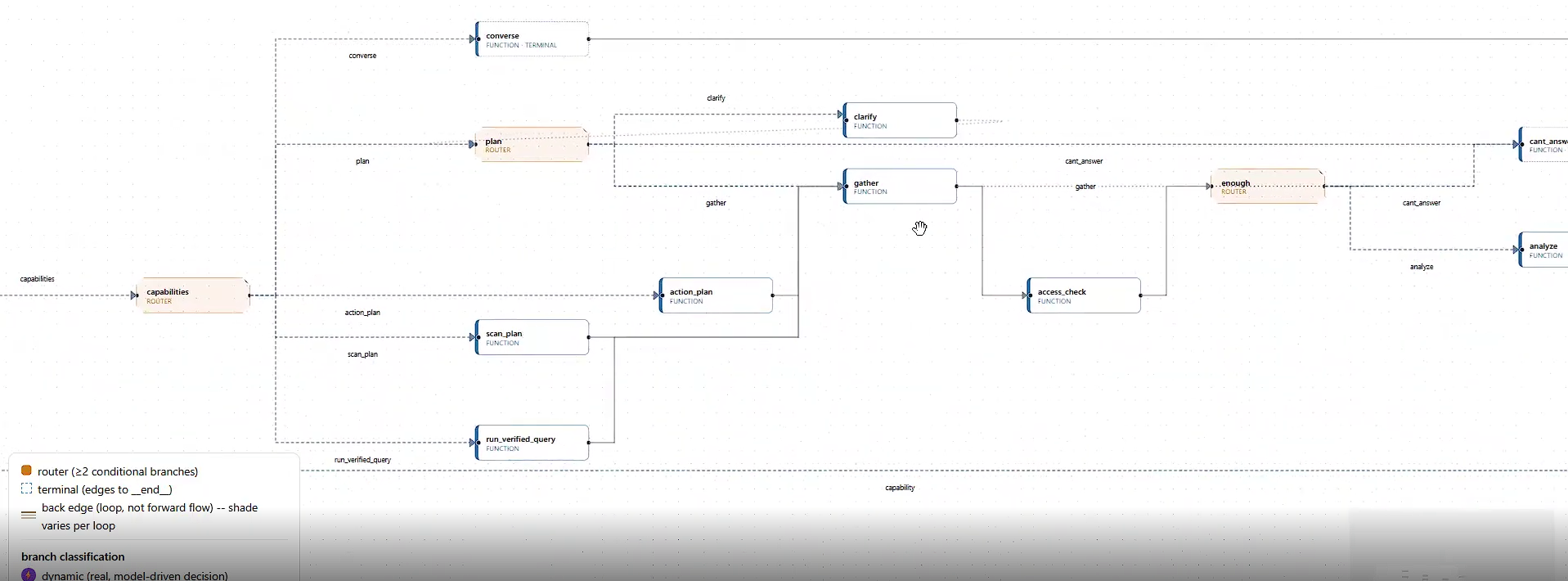
render-langgraph locates a compiled graph (via langgraph.json, an AST scan of the target file, or an explicit path:attribute), imports it, calls get_graph(xray=True), and serves the resulting node/edge structure through a React Flow + elkjs viewer with live reload. Nothing runs; the graph is inspected, not executed.
The viewer doesn’t just draw boxes and arrows: it classifies what it finds. Routers (nodes with two or more conditional branches) are marked distinctly from plain function nodes, terminal nodes (edges to __end__) are flagged, and back-edges (loops, as opposed to forward flow) get their own visual treatment so a cyclic supervisor graph doesn’t read as a straight line with a bug in it.
Usage
pip install render-langgraph
render-langgraph                          # auto-discovery
render-langgraph src/agent/graph.py:graph # explicit target
render-langgraph --static path.py         # AST-only, no import
render-langgraph --json                   # structure only, no server
Status
v0.1 walking skeleton: core extraction, discovery, and the viewer work, but it’s early days. MIT licensed.